Magic GraphQL servers
Instant GraphQL servers for testing and exploration, prepopulated with the graph data which is inlined in the server URLs.
How it works
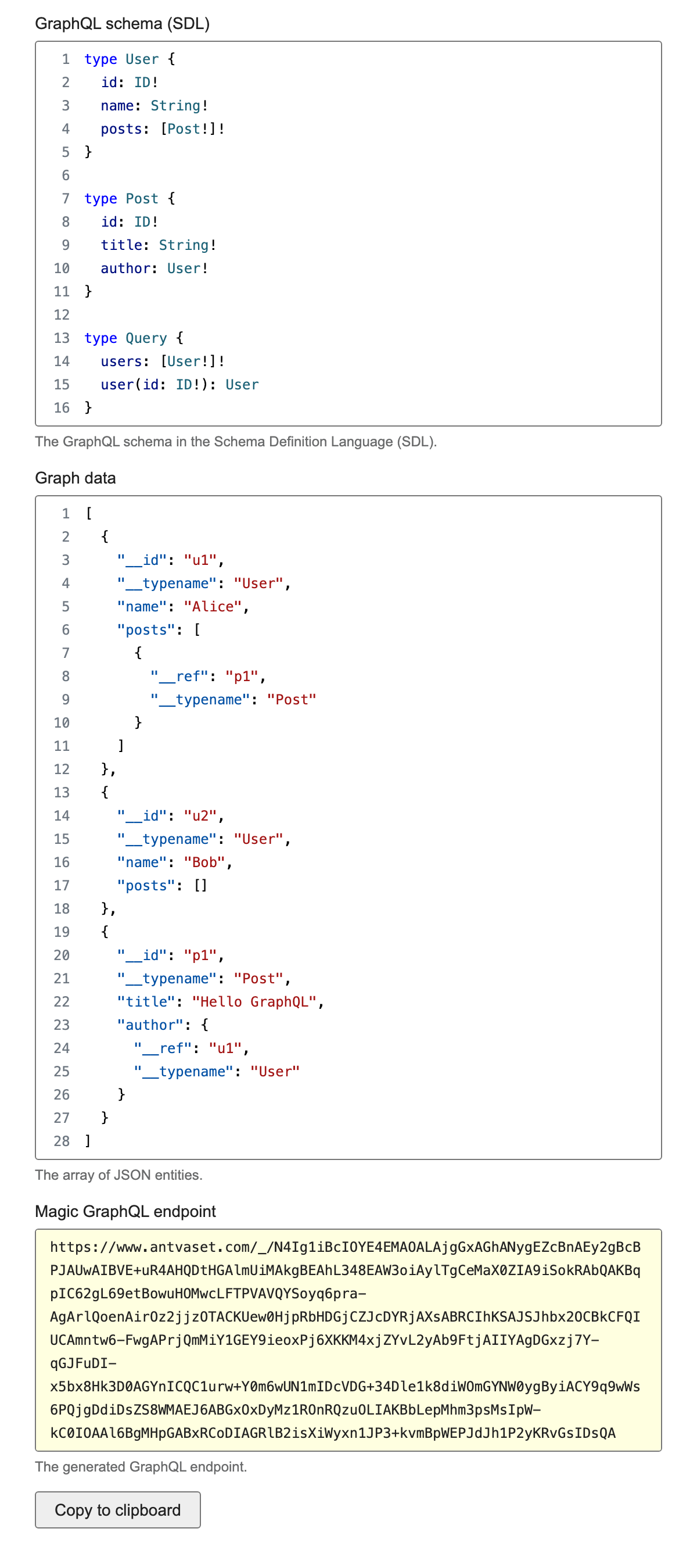
- You enter the GraphQL schema and JSON entities (server data). The data is represented as a normalized flat graph in which every instance has a
__typenameand__id. References are represented as objects with a__typenameand__refwith the ID of the linked entity. - The tool generates a URL that directly embeds the data with some additional metadata (serialized, compressed, URL-encoded).
- The generated URL is a functional GraphQL endpoint that can be used to query the graph stored on the virtual GraphQL server.
Use cases and implications
When you only need a quick GraphQL server to do some testing or experiment with the GraphQL API, it's much easier to use these "magic" GraphQL endpoints than to spin up a regular GraphQL server.
Since the data and configuration are stored in the URL itself (similar to how data URIs encapsulate their content), every individual URL corresponds to an immutable (read-only) GraphQL server that's been seeded with the data from the URL.
Try it now
GraphQL schema (SDL)
The GraphQL schema in the Schema Definition Language (SDL).
Graph data
The array of JSON entities.
Magic GraphQL endpoint
The generated GraphQL endpoint.